Why V.O.D is a QC metric
V.O.D directly reflects formulation, density, particle size and the absence of defects in a finished explosive. A stable V.O.D measured across production batches confirms that the manufacturing process is in control. A drift signals a change in raw materials, mixing, sensitization or aging.
For end users, V.O.D is the acceptance test that links a supplier specification to actual field behavior. It complements detonation pressure, brisance and energy measurements that are used in research.
Materials and what is typically checked
- High explosives (TNT, RDX, HMX based compositions): V.O.D versus density, diameter effect, critical diameter verification.
- Industrial bulk explosives (ANFO, emulsions, watergels): in production V.O.D for batch acceptance, in hole V.O.D for field performance.
- Detonating cords: actual core load propagation speed.
- Detonators: real delay versus nominal, batch tolerance and aging.
- Propellants and pyrotechnics: burning rates, ignition delay, deflagration to detonation transitions where applicable.
Laboratory versus field QC
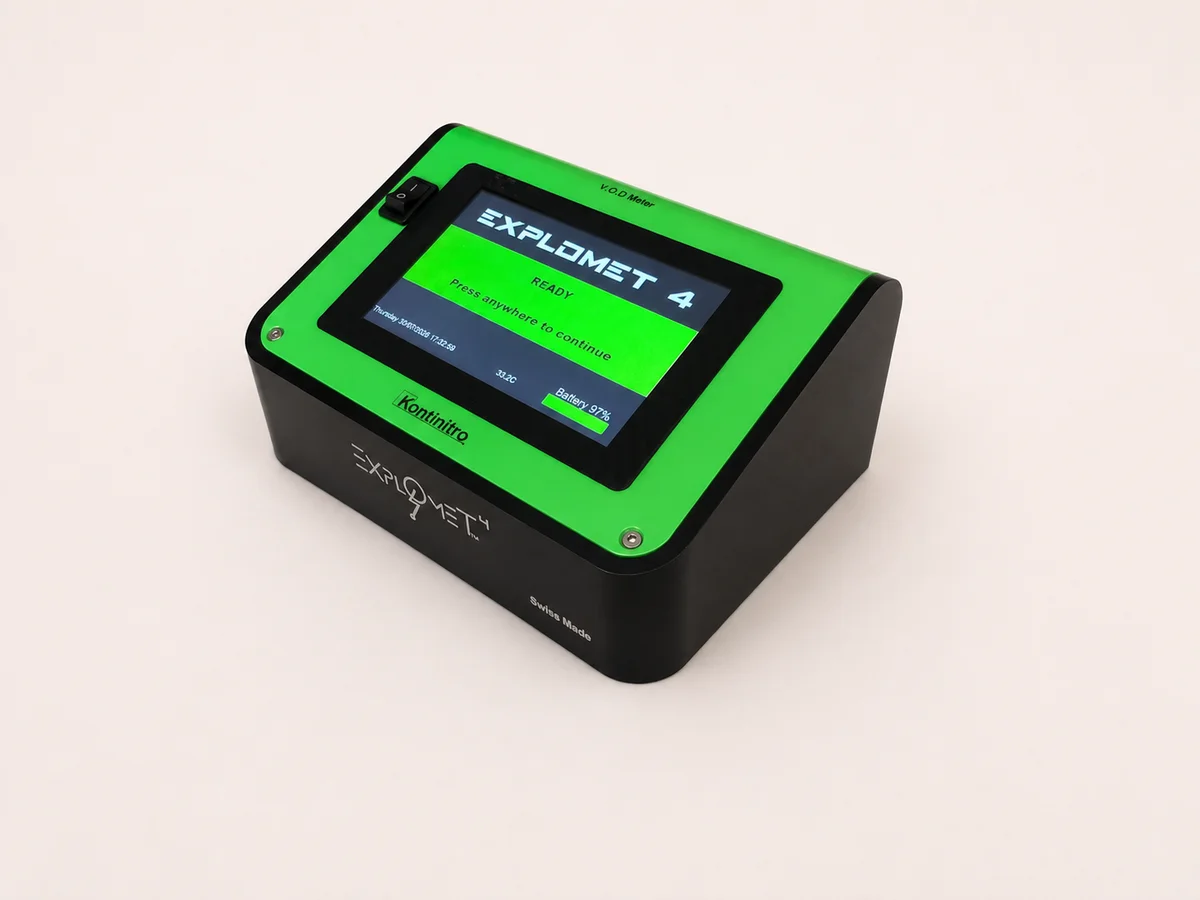
In the laboratory, V.O.D is measured under controlled diameter, confinement and density. Instruments need precise timing and reproducible setup. The Explomet 2 Series is built for this context, with ±0.01 microsecond precision and a self calibrating quartz time base.
In the field, the same physical measurement is performed in the blast hole. The Explomet 3 paired with the EasyProbe System or DCS Duplex Cable System brings five V.O.D measurements per blast in dry or wet holes. For detonator delay QC, the Detomet 2.0 returns the delay of one to five detonators per shot.
For large QC campaigns, the High Capacity Systems extend the platform to 20, 24 or 30 channels.
Where to go next
See What is V.O.D for fundamentals, measurement methods for a method comparison, and the energetic materials application page for the Kontinitro deployment context.